



Blog
Latest insights and updates
AI Automation vs AI Agents: Understanding the Future of Intelligent Systems
The $100 Billion Question Every Business Faces
Imagine walking into your office five years from now. Half your colleagues are collaborating with AI agents that can think, plan, and make decisions. The other half are using AI automation to eliminate repetitive tasks. Which group is driving more value? Which technology should you bet on today?
This isn't science fiction, it's the reality unfolding in 2025. Companies are pouring over $100 billion into AI technologies, from AI automation for business to AI agents for enterprises, but here's the catch: most don't understand the fundamental difference between the two. It's like confusing a calculator with a mathematician. Both work with numbers, but only one can solve novel problems.
The stakes couldn't be higher. Choose wrong, and you'll waste millions on the wrong technology. Choose right, and you'll build a competitive advantage that compounds for years. Let's decode this critical distinction that's reshaping every industry from banking to healthcare.
The Tale of Two AIs: Understanding the Core Difference
AI Automation: Your Digital Assembly Line
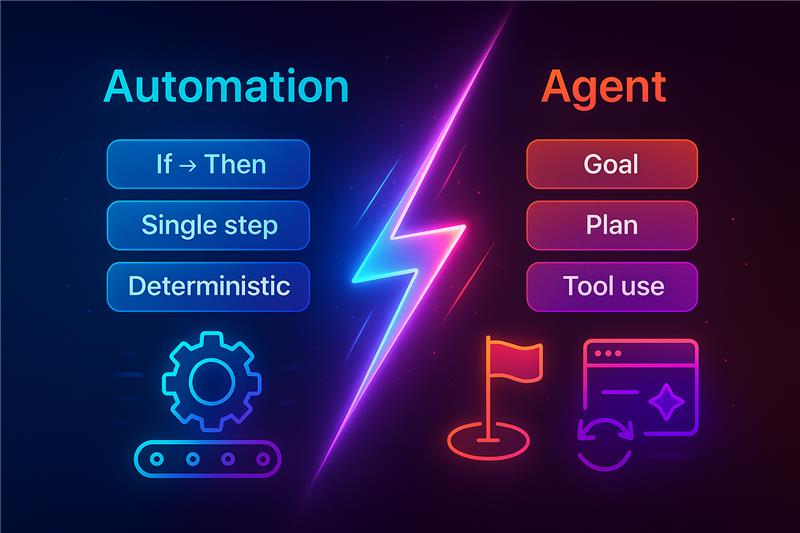
Think of AI automation as the world's most sophisticated assembly line worker. It follows rules, executes tasks perfectly, and never gets tired. But ask it to do something outside its programming? It's lost.
What AI Automation Really Is:
- Rule-based systems that follow predetermined "if-then" logic
- Process optimizers that streamline repetitive tasks
- Digital workers that execute structured workflows
- Consistency machines that deliver the same output every time
Picture a bank processing thousands of loan applications. AI automation can extract data, verify documents, check credit scores, and route applications, all following predefined rules. It's fast, accurate, and reliable. But if a unique situation arises? Human intervention required.
The Technical Architecture:
Input → Predefined Rules → Processing → Predictable Output
It's linear, deterministic, and wonderfully boring—exactly what you want for mission-critical processes.
AI Agents: Your Digital Problem Solver
Now imagine hiring a brilliant consultant who can analyze situations, develop strategies, and adapt on the fly. That's an AI agent, a system that doesn't just follow rules but creates its own path to achieve goals.
What AI Agents Really Are:
- Autonomous systems that perceive, reason, and act
- Goal-oriented entities that plan multi-step strategies
- Adaptive learners that adjust based on outcomes
- Collaborative partners that work with humans and other agents
Consider a supply chain crisis. An AI agent doesn't just flag the problem, it analyzes root causes, simulates solutions, negotiates with suppliers, adjusts pricing, and implements fixes. All while you're sleeping.
The Technical Architecture:
Goal → Perception → Planning → Action → Learning → Adaptation
It's dynamic, intelligent, and slightly unpredictable, like having a genius employee who occasionally surprises you.
Real Stories from the Frontlines
The Automation Champions
The Co-operative Bank's Speed Revolution
- Challenge: Processing payments took 10 minutes each
- Solution: AI automation for CHAPS payment processing
- Result: 20-second processing time a 30x improvement
- Key Insight: When the process is clear, automation is king
Healthcare's Administrative Cure
- Organization: AGS Health
- Application: Medical record processing and insurance claims
- Impact: 90% reduction in processing errors
- Learning: Compliance-heavy tasks love automation's consistency
The Agent Innovators
Klarna's Customer Service Revolution
- Scale: 2.3 million conversations handled autonomously
- Performance: 75% of all customer interactions resolved
- Quality: Satisfaction scores matching human agents
- Secret: Agents that understand context, not just keywords
JPMorgan's Legal Brain
- System: LAW (Legal Agentic Workflows)
- Accuracy: 92.9% across complex legal queries
- Capability: Multi-agent collaboration for document analysis
- Breakthrough: Agents that reason through legal complexity
The Strategic Decision Framework
| Feature | Automation | Agents |
|---|---|---|
| If→Then rules (rule-based) | ||
| Goal-driven behavior | ||
| Multi-step planning | ||
| Deterministic / predictable output | ||
| Learns & adapts from outcomes | ||
| Handles dynamic / ambiguous situations | ||
| Best for repetitive, regulated workflows | ||
| Quick ROI (~6-18 months) | ||
| Lower budget ($50k-$200k) | ||
| Heavy governance required | ||
| Requires process redesign / upkeep | ||
| Great for empathetic customer interactions |
When to Choose AI Automation
Perfect For:
- High-volume, repetitive tasks (invoice processing, data entry)
- Regulated processes requiring audit trails
- Stable workflows that rarely change
- Quick ROI requirements (6-18 months)
- Budget-conscious implementations ($50K-$200K)
Avoid When:
- Processes require judgment calls
- Situations vary significantly
- Learning from experience matters
- Creative problem-solving is needed
When to Deploy AI Agents
Perfect For:
- Complex multi-step problems
- Dynamic, changing environments
- Customer interactions requiring empathy
- Strategic decision-making
- Competitive differentiation plays
Avoid When:
- Processes are simple and stable
- Budgets are tight (<$200K)
- Risk tolerance is low
- Regulatory compliance is rigid
The Hidden Costs Nobody Talks About
AI Automation's Hidden Expenses
- Process redesign: 20-30% of project cost
- Change management: Often exceeds technology costs
- Maintenance: 15-20% annually as processes evolve
- Integration complexity: Legacy system connections
AI Agents' Surprise Bills
- Governance frameworks: $500K+ for enterprise-grade
- Specialized talent: AI architects command $300K+ salaries
- Computing resources: 10x automation's requirements
- Risk management: Insurance and compliance costs
The Hybrid Approach: Having Your Cake and Eating It Too
Smart organizations aren't choosing between automation and agents, they're orchestrating both. Here's the playbook:
Phase 1: Foundation Building (Months 1-6)
- Deploy automation for clear, repetitive processes
- Capture quick wins to build organizational confidence
- Establish data infrastructure for future agent deployment
- Train teams on AI collaboration basics
Phase 2: Intelligent Enhancement (Months 7-12)
- Introduce simple agents for customer service
- Create hybrid workflows combining both technologies
- Develop governance frameworks for autonomous decisions
- Measure and optimize performance metrics
Phase 3: Transformation (Year 2+)
- Deploy multi-agent systems for complex operations
- Redesign processes around AI capabilities
- Scale successful patterns across the organization
- Innovate new business models enabled by AI
Industry-Specific Playbooks
Financial Services
- Automation: Transaction processing, compliance reporting
- Agents: Risk assessment, fraud detection, wealth management
- Leader Example: JPMorgan processes 12+ million research queries annually
Healthcare
- Automation: Appointment scheduling, billing, record management
- Agents: Diagnostic assistance, treatment planning, patient monitoring
- Innovation Zone: Clinical decision support systems
Retail & E-commerce
- Automation: Inventory management, order processing
- Agents: Personal shopping assistants, dynamic pricing, demand forecasting
- Success Story: Amazon's recommendation agents drive 35% of revenue
Manufacturing
- Automation: Production line control, quality checks
- Agents: Predictive maintenance, supply chain optimization
- Future State: Self-optimizing factories
The 2025-2030 Roadmap
What's Coming Next
- Market Growth: AI agents expanding from $5.4B to $47B
- Adoption Curve: 15% of work decisions made by AI by 2028
- Technology Convergence: "Agentic automation" becoming standard
- Regulatory Evolution: EU AI Act implementation reshaping practices
Emerging Capabilities
- Multi-modal agents: Processing text, voice, images simultaneously
- Swarm intelligence: Thousands of agents collaborating
- Emotional AI: Agents understanding and responding to human emotions
- Quantum-enhanced: Next-generation processing power
Your Action Plan: Starting Monday Morning
Week 1: Assessment
- Map your top 10 repetitive processes
- Identify 3 complex problems worth solving
- Calculate current process costs
- Assess team AI readiness
Month 1: Pilot Planning
- Select one automation opportunity
- Choose one agent use case
- Build business cases for both
- Secure executive sponsorship
Quarter 1: Implementation
- Launch automation pilot
- Begin agent proof-of-concept
- Establish success metrics
- Create feedback loops
Year 1: Scaling
- Expand successful pilots
- Build AI governance framework
- Develop internal AI capabilities
- Measure ROI and iterate
The Bottom Line: Your Competitive Edge
The difference between AI automation and AI agents isn't just technical, it's strategic.
- Automation gives you efficiency; agents give you intelligence.
- Automation follows your rules; agents write new ones.
- Automation saves costs; agents create opportunities.
The winners in 2025 won't be those who choose one over the other, but those who understand when to deploy each. They'll automate the predictable to free resources for agents to tackle the impossible. They'll build foundations with automation while preparing for agent-driven transformation.
The question isn't whether AI will transform your business, it's whether you'll lead that transformation or follow others who do. The tools are ready. The playbooks exist. The only variable is your decision to act.
Start small. Think big. Move fast. The future belongs to those who understand that AI automation and AI agents aren't competing technologies, they're complementary forces that, when combined strategically, create unstoppable competitive advantage with AI.
Next Steps:
Automation cuts your costs. AI agents create your opportunities. Together, they build your competitive edge.
At TBen Innovation, we help businesses unlock the full potential of AI automation for business and AI agents for enterprises: https://tbeninnovation.com/
Share it!
Continue Reading