



Blog
Latest insights and updates
How AI Solves Key Challenges in Customer Service and Commerce
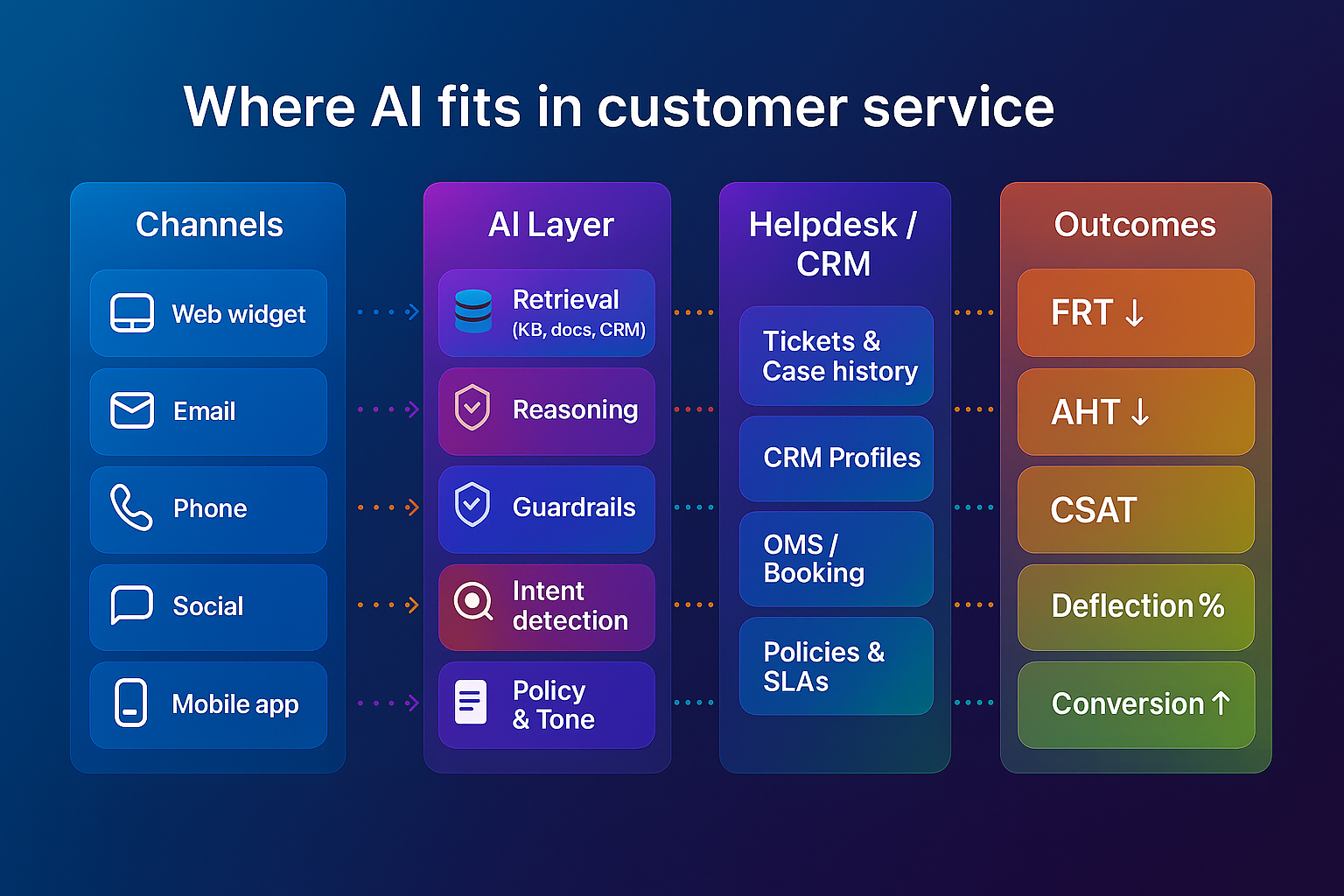
Key takeaways
Most companies struggle with long response times, repetitive tickets, low personalization, and rising support costs. AI fixes this with 24/7 chatbots, agent assist, smart routing, recommendation engines, and automated workflows. Start small (FAQ automation or order-status bot), measure impact (FRT, AHT, CSAT, conversion), then scale.
Why this matters now
Customers expect instant, accurate help across chat, email, and social. Teams are stretched. Budgets are tight. AI lets you automate the repetitive, augment human agents, and personalize at scale, so you can grow without growing headcount.
The top problems, and how AI fixes them
1) Slow responses & ticket backlogs
- The pain: Long queues, after-hours silence, missed SLAs.
- AI fix: 24/7 chatbots answer FAQs, order status, returns, store hours, appointment booking. Smart triage routes complex issues to the right agent.
- Impact to expect: Lower First Response Time (FRT), fewer abandoned conversations, higher CSAT.
2) Agents overloaded with repetitive questions
- The pain: Agents spend hours on password resets, tracking updates, and policy questions.
- AI fix: Agent Assist suggests answers in real time and auto-drafts replies; workflow bots handle simple requests end-to-end.
- Impact to expect: Lower Average Handle Time (AHT), more resolved tickets per agent, less burnout.
3) One-size-fits-all experiences
- The pain: Generic replies, irrelevant offers, low conversion.
- AI fix: Recommendation engines tailor products, articles, and next-best actions. Bots personalize replies using customer history.
- Impact to expect: Higher conversion, bigger basket size, better retention.
4) Abandoned carts & undecided buyers
- The pain: Shoppers leave without buying; agents can't reach everyone in time.
- AI fix: Proactive chat triggers on exit intent or confusion. Email/SMS nudges with contextual help or incentives.
- Impact to expect: More recovered carts, higher revenue per session.
5) Knowledge scattered across tools
- The pain: Policies in Google Docs, product specs in PDFs, answers in Slack.
- AI fix: Retrieval-augmented chat pulls the right answer from your documents and knowledge base instantly.
- Impact to expect: Consistent answers, faster onboarding, fewer escalations.
6) Inconsistent quality & compliance risks
- The pain: Tone, promises, and policy adherence vary by agent.
- AI fix: Quality AI reviews replies before sending, flags risky language, enforces policy, and suggests friendlier tone.
- Impact to expect: Fewer refunds/complaints, stronger brand voice, lower risk.
Five high-impact use cases (with quick wins)
A) E-commerce & retail
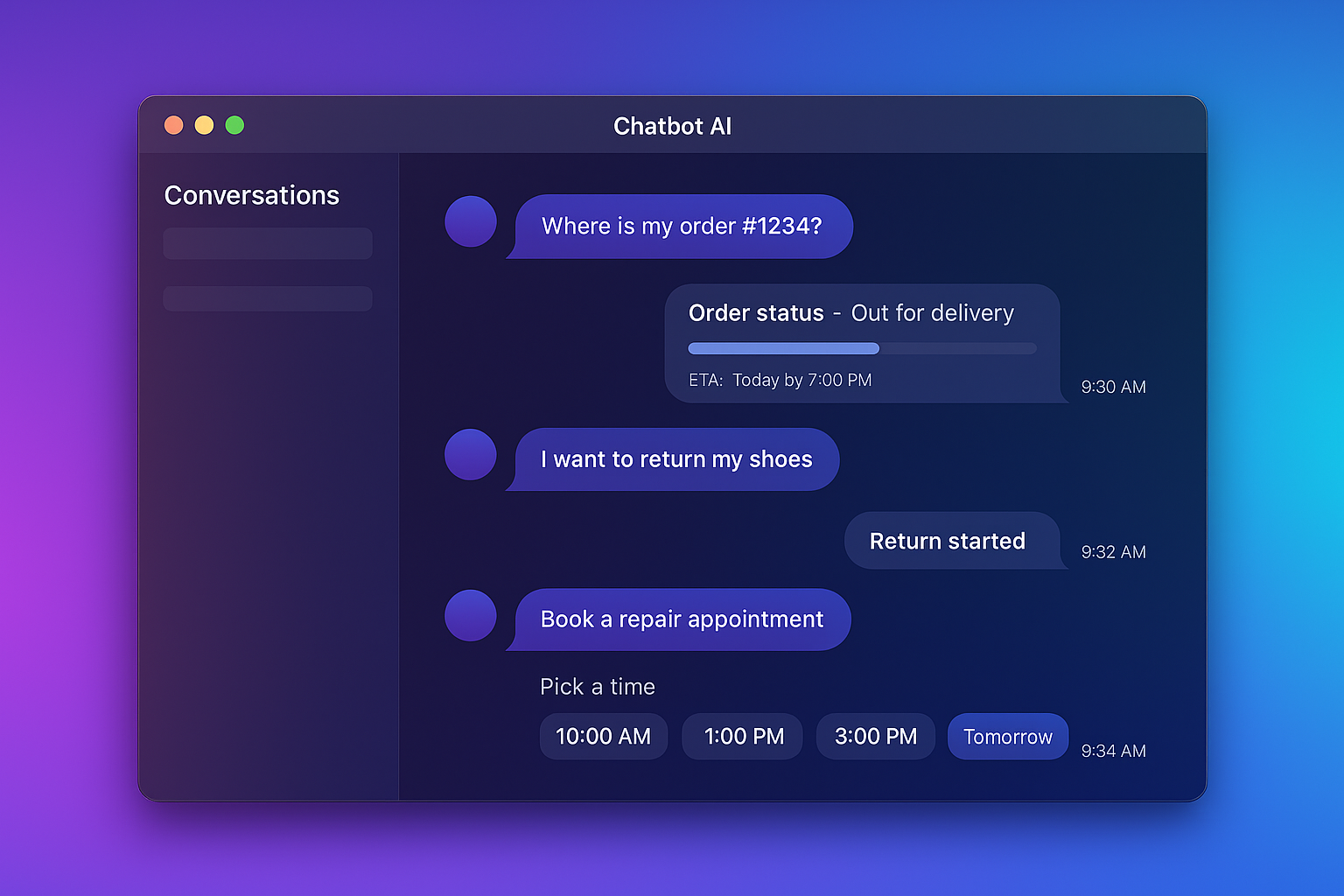
- Quick win: Order-status & returns bot; product-finder quiz.
- Add-ons: Back-in-stock alerts, personalized recommendations, store locator.
B) Financial services (cards, payments, micro-lending)
- Quick win: Smart triage for KYC/FAQ; secure balance & transaction info via authenticated chat.
- Add-ons: Proactive outreach for failed payments; anomaly alerts for agents.
C) Telecom & utilities
- Quick win: Self-service for billing, outage info, plan upgrades.
- Add-ons: Intelligent appointment scheduling; proactive outage updates.
D) Healthcare clinics
- Quick win: Appointment booking & reminders; pre-visit questionnaires.
- Add-ons: Symptom-to-service routing; post-visit follow-ups.
- Note: Emphasize privacy, consent, and PHI handling.
E) Real estate
- Quick win: Lead qualification bot (budget, location, timing) + instant viewing requests.
- Add-ons: Property match recommendations; status updates for buyers/tenants.
Implementation roadmap (90 days)
Days 0-30: Prove value fast
- Pick 1-2 high-volume intents (e.g., order status, returns, opening hours).
- Connect to your knowledge base & order system.
- Launch web chat; add triggers on high-exit pages.
Days 31-60: Augment your agents
- Roll out Agent Assist in your help desk (draft replies, knowledge suggestions).
- Add proactive cart-recovery chat + email/SMS journeys.
- Start quality review AI (tone, policy, compliance checks).
Days 61-90: Personalize & scale
- Enable product/content recommendations in chat & email.
- Automate common workflows (refunds under threshold, appointment booking).
- Expand to social DMs and WhatsApp if relevant.
Data & integration checklist
- Source of truth: CRM, order management, booking system, help desk, knowledge base.
- Access: Read/write APIs or secure integrations.
- Governance: Data retention, consent, audit logs, role-based access.
- Security: Encryption in transit/at rest, SSO/SAML, least-privilege permissions.
What to measure (and how to report it)
- Speed: FRT, AHT, Time to Resolution.
- Deflection: % handled fully by bot; containment rate.
- Quality: CSAT, QA pass rate, re-open rate.
- Revenue: Conversion rate, recovered carts, AOV, LTV.
- Cost: Tickets per agent, cost per contact.
Set a baseline for 2-4 weeks, then compare weekly after launch. Visualize in a simple dashboard.
Risks & how to manage them
- Hallucinations / incorrect answers: Ground the bot in your KB; restrict to "answer only from sources."
- Privacy: Don't store sensitive data unnecessarily; mask PII; honor deletion requests.
- Tone mismatches: Use style guidelines + QA pre-send checks.
- Change fatigue: Pilot with a small team; train; share quick wins.
FAQ (for your stakeholders)
Will AI replace our agents?
No, AI handles repetitive tasks so agents can focus on complex, human-centered cases.
How long until we see results?
Most teams see faster responses and fewer simple tickets within 2-4 weeks of a focused pilot.
Do we need to rebuild our stack?
No, modern AI layers integrate with your help desk, CRM, and knowledge base.
Clear next step
Want a 15-minute walkthrough of a pilot tailored to your data and channels?
Book a quick call with Tben Innovation: contact@tbeninnovation.com
Share it!
Continue Reading