



Blog
Latest insights and updates
AI in Education: Personalization, Faster Feedback, Fewer Repetitive Tasks
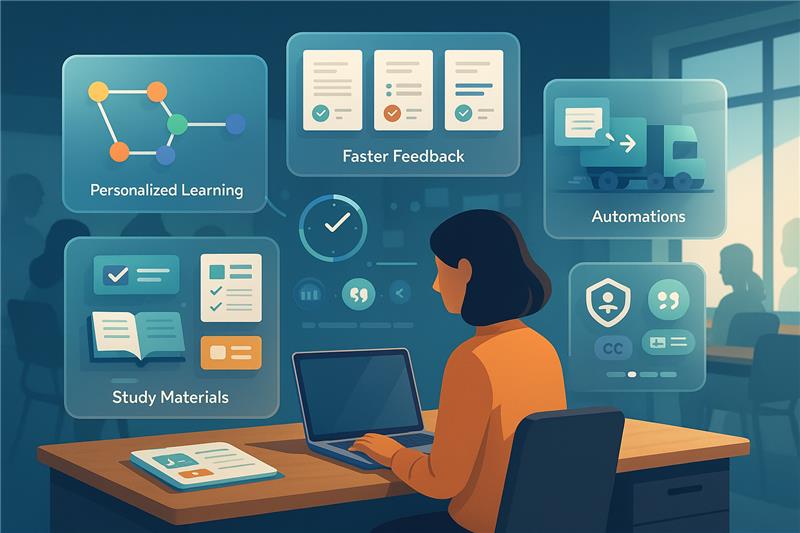
Summary (1 minute): AI helps teachers focus on teaching. It personalizes learning paths, returns feedback faster, and automates repetitive admin so staff get time back and students get clearer guidance. Start small, measure outcomes, and scale what works.
Why this matters now
- Content sprawl: slides, PDFs, videos, forums, resources multiply every term.
- Higher expectations: students want timely, tailored help.
- Tight budgets: teams need hours back, not bigger tool stacks.
AI is best used as a force multiplier: let it structure, summarize, and suggest---while humans coach, decide, and assess.
1) Personalization without chaos
What it looks like
- Quick diagnostics to surface weak concepts.
- "Next best step" activities by topic & difficulty.
- Multiple explanations (text, step-by-step, analogy, visual).
How to implement
- Pick 3--5 core competencies per course.
- Curate a small bank of micro-exercises (easy/medium/hard).
- Route students to the right exercise based on recent results.
Tip: Explain why an activity was recommended ("Chain rule errors → try these three worked examples").
2) Faster, more consistent feedback
What it looks like
- Drafted comments aligned to a rubric (clarity, evidence, structure, citation).
- Highlighted excerpts tied to criteria.
- A short "what to improve next" paragraph.
How to implement
- Convert your rubric into 3--5 plain-language criteria.
- Ask AI for comment candidates per criterion---not the grade.
- You review, edit, and decide the score.
Tip: Separate feedback (AI assists) from grading (teacher owns).
3) Less admin, more teaching
What it looks like
- Summarized threads & meeting notes with action items.
- Auto-generated reminders/checklists for recurring tasks.
- Normalized data (names, IDs, dates) ready for reports.
How to implement
- Pick 3 repetitive processes (e.g., weekly recap, assignment reminders, attendance notes).
- Provide 1--2 example inputs + a target template.
- Let AI fill the template; staff skim and send.
Tip: Keep output formats standard ("Decisions / Owners / Due dates") so teams trust them.
4) Better study materials, built faster
What it looks like
- Chapter summaries, flashcards, and glossaries from your existing materials.
- Exercise variants (basic → applied → case).
- Script outlines for short explainer videos.
How to implement
- For the next module, gather core resources.
- Generate: a 10-item quiz (balanced difficulty) + answer key + one-page summary.
- Edit once, then save as templates for the term.
Tip: Tag outputs by topic and difficulty to recombine next year.
5) Responsible use & academic integrity
What it looks like
- Clear guidelines on acceptable AI use and citation.
- Similarity checks and citation assistance.
- Assignments that emphasize process (drafts, reflections, oral defense).
How to implement
- Publish a one-page policy: when AI is allowed, how to cite it, what crosses the line.
- Add a reflection box to assignments ("What did AI help with? What did you revise?").
- Mix formats to reduce copy-paste risks.
6) Accessibility & inclusion by default
What it looks like
- Transcriptions/captions for lectures.
- Plain-language versions of complex readings.
- Text-to-speech and adjustable reading levels.
How to implement
- Produce a "plain-language" version for each key document.
- Add a "listen" option and high-contrast format in course hubs.
Tip: Universal design helps every learner, not just those with accommodations.
A simple 30-day starter plan
Week 1 --- Scope
- Choose two pilot courses + one cross-course process (e.g., weekly recap).
- Set 3 goals (e.g., prep time saved, feedback turnaround, fewer repetitive questions).
Week 2 --- Prototype
- Make one rubric AI-readable (3--5 criteria).
- Generate: one quiz set, two chapter summaries, one FAQ draft.
- Trial a "next-step" micro-exercise flow for a single topic.
Week 3 --- Test & refine
- Test with 3--5 teachers + a small student group.
- Tweak prompts, criteria, and formats.
Week 4 --- Go live (pilot)
- Publish a 2-page quick guide for staff and students.
- Review outcomes; keep what works, archive what doesn't.
- Plan the next two courses to onboard.
Prompts you can copy
- Rubric-aligned feedback "Using this rubric (clarity, evidence, structure, citation), draft specific, constructive feedback for this essay. Give 1--2 suggestions per criterion and a final 'next steps' paragraph. Do not assign a grade."
- Personalized practice "From these quiz results, identify the three weakest concepts and generate one scaffolded exercise per concept (easy → applied). Include brief hints, not full solutions."
- Weekly recap "Summarize this week's class notes and forum posts in 8--10 bullet points. Then propose three review questions and list upcoming deadlines."
- Study guide "Create a one-page study guide for Topic X: key ideas, common mistakes, and three practice questions ordered by difficulty."
Measuring success (easy KPIs)
- Prep time per session (before/after).
- Feedback turnaround time (median hours).
- Module completion & pass rates.
- % of recurring questions answered via FAQ.
- Teacher & student satisfaction (5-item pulse).
Common pitfalls (and fixes)
- Over-automation: keep teachers in control; AI suggests, humans decide.
- Messy inputs: clean materials → better outputs.
- Big-bang launches: start small; iterate every two weeks.
- Opaque rules: publish clear AI-use guidelines.
Conclusion & call to action
AI isn't a shortcut to learning, it's a multiplier for teaching. Personalization focuses effort, faster feedback sustains momentum, and automation gives time back to the people who make education work.Want a pilot plan tailored to your programs? Contact us to scope a 30-day rollout with clear goals and KPIs.
Share it!